
The United States is now home to millions of secret Canadians who have no idea that they are currently eligible for a second citizenship, passport, and all the rights that come with it.
Under Canada’s new citizenship law, these Americans are already citizens; they just need to follow the trail of clues to prove it and avail themselves of all the benefits of their new status.
This article compiles some of the most telling clues to Canadian descent, with the consideration that while the reported numbers of eligible Americans are already large, they almost certainly undercount the truth because the evidence has been quietly erased over the decades.
Get a Free Consultation on Applying for Proof of Canadian Citizenship
Most are unaware or completely miss the breadcrumbs in this regard: for example, a last name that was changed at the border generations ago, or a branch of the family that settled in New England, Louisiana, or the Upper Midwest.
What the law changed
Canada’s new citizenship rules, introduced through Bill C-3, removed what was called the first-generation limit — a rule that had capped citizenship by descent at one generation born abroad.
If you were born before December 15, 2025, and can trace an unbroken line to a Canadian ancestor, you qualify. It doesn’t matter how many generations have passed.
Consider a teacher in Ohio whose great-grandmother was born in Quebec, then moved to Michigan as a child. Under the old rule, that link was too far back to count. Under the new law, it’s enough — and if she qualifies, so do her children. You’re not applying to become Canadian. If you qualify, you already are one — you’re applying for the certificate that proves it.
The numbers, and why they undercount those eligible
The reported estimates are already large. In New England, roughly one in four people may be eligible. Connecticut alone accounts for an estimated 300,000 eligible residents. Vermont and New Hampshire both rank among the top states by share of eligible population.
But those figures likely undercount the true number, because the trail has gone cold for so many families.
Between 1840 and 1930, close to 900,000 French-speaking Canadians left Quebec for the textile mills of New England:
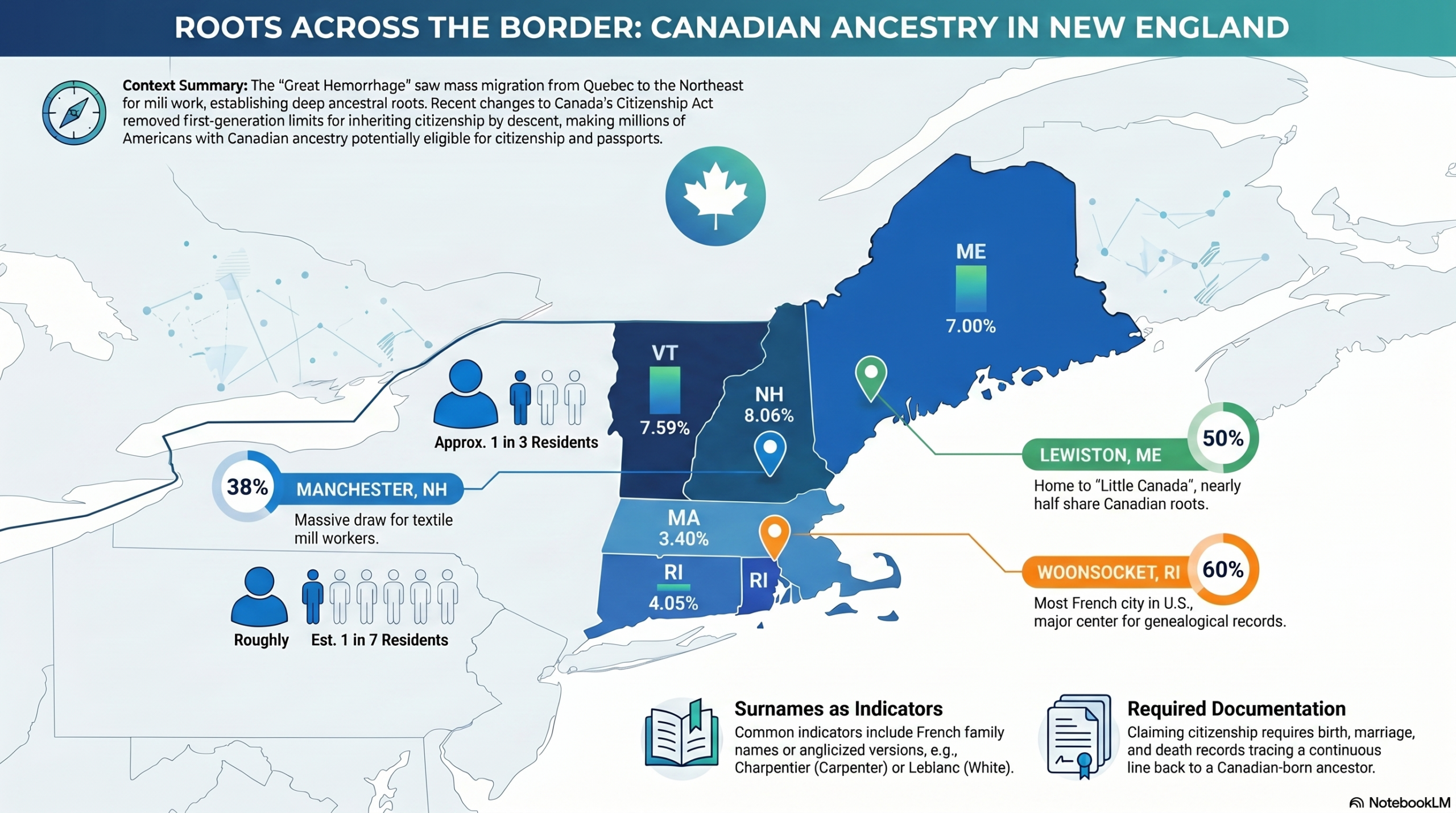
Their names often changed — anglicized more often, and in more varied ways, than those of any other immigrant group in the country, according to Marc Picard, a linguist who has documented hundreds of these transformations.
Where the clues hide
Some signals are worth checking first. Geography is one. Family roots in New England point to the Quebec migration.
So does the Upper Midwest — Michigan, Minnesota, Wisconsin. Several states now rank as hotspots for eligibility.
Surnames are the other signal, and some carry a strong statistical tilt.
An American named Tremblay is about 114 times more likely to have Canadian roots than a typical surname would suggest. For Ouellet, the figure is 368 times. Even common names like Roy or Desjardins skew heavily Canadian. And the anglicized versions — White, King, Wood, Carter, Mayhew — keep the connection hidden in plain sight.
This is to say nothing of dit names, which regularly hide a whole other (French-Canadian) half to a person’s last name, where their roots are apparent.
None of this is proof. A French surname or a Maine address, though strong indicators, only tell you where to look.
What most people won’t do
The interest is real. Quebec’s national archives reported a roughly 3,000% jump in requests for vital records over the past year, most of them from Americans.
Processing for a proof of citizenship certificate currently takes about 15 months, and the line is getting longer.
Still, the paradox holds. Millions qualify. Most won’t apply — not because the process is hard, but because they never connect their own family to any of this.
If you find that several clues and signals point towards a possible Canadian ancestor, it may be well worth your time to verify this connection.
If a name, a place, or a half-remembered family story points north, CanadaVisa’s citizenship by descent eligibility checker will tell you in about 30 seconds whether it’s worth pursuing.
Get a Free Consultation on Applying for Proof of Canadian Citizenship