Millions of Americans have two independence days this year. Most don’t know it

Two flags go up this week, three days apart. Canada marks Canada Day on July 1, and the United States celebrates its independence on July 4.
All American citizens own the latter, but millions of them own both and haven't found out yet.
This is a legal fact, not a metaphor. Under Canada's new citizenship laws (recently amended with the passing of Bill C-3), millions of Americans count as Canadian citizens already, and the reason runs through their own families.
Get a Free Consultation on Applying for Proof of Canadian Citizenship
Canada changed its citizenship law in December 2025. The old rules capped citizenship by descent, the citizenship a family passes down through its line, at one generation born outside the country.
If you were born before December 15, 2025, and can trace an unbroken line back to a Canadian ancestor, you may already be a citizen, however many generations have passed. The ancestor never needed a passport or to have lived in Canada as an adult.
If the line holds, a proof of citizenship certificate can be granted, further entitling the holder to a Canadian passport and all the legally recognized rights of a citizen.
How far back does the line go?
American actress Chloë Sevigny is a case study in how far. The actress was born in Springfield, Massachusetts, and built her name in downtown New York, about as American a résumé as they come.
Her claim to Canada sits five generations up, with a great-great-great-grandfather, Charles-Eusèbe Philias Sevigny, born in Ste-Pie-de-Bagot, Quebec. He left the province for Massachusetts, and the family stayed. Under the old law, a Canadian that far back counted for nothing. Under the new one, he's enough to make Sevigny a Canadian, along with relatives who share the same line.
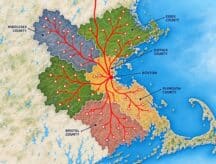
That move Charles-Eusèbe made, from a Quebec parish to a Massachusetts town, was one of hundreds of thousands like it. Between 1840 and 1930, close to 900,000 French-speaking Canadians left Quebec for the textile mills of New England, packing into dense neighbourhoods that locals called "Little Canada" in Lewiston, Maine; Manchester, New Hampshire; Lowell, Massachusetts; and Woonsocket, Rhode Island. They built their own newspapers, churches, and schools to hold onto the French language and the Catholic faith.
Get a Free Consultation on Applying for Proof of Canadian Citizenship
Then time did its work. The surnames shifted at the border over the decades. Leblanc turned into White, Roy into King, Charpentier into Carpenter. Maine now carries the highest share of French ancestry of any US state, roughly one in five, and those descendants are still there. Many have lost the thread connecting them to it.
A New England address helps, though plenty of eligible Americans live nowhere near it, because the arithmetic of a family tree rewards the further reach. Four generations back, you have 16 ancestors to check. Five generations back gives you 32, and six gives you 64. The deeper you map your family, the better the odds that one of those people crossed a border that's now Canadian, left a province before it joined the country, or changed a name along the way. One is enough.
The part that surprises people most concerns what the certificate actually is. A qualifying American isn't becoming a Canadian; they already are one, and the application only secures the proof.
The process skips the typically required language test, the residency requirement, the citizenship exam, and the oath. Because relatives share the qualifying ancestor, one person's discovery tends to open the same door for siblings, cousins, and their kids.
So why do so few eligible Americans pursue it?
Most never make the connection in the first place. Where people have looked, the interest shows: Quebec's archives reported a roughly 3,000% jump in requests for old records over the past year, most of them from Americans.
Yet most who qualify still won't apply, and the paperwork is rarely the reason. The grandmother who spoke French at the stove, the relative "from up north," the maiden name nobody can spell: these clues sit in plain sight, waiting for someone to notice.
That noticing is much of the distance between an American reader and a second Independence Day.
This Canada Day is the first to fall under the new law, which makes July 1 more than a neighbour's holiday for millions of Americans. It's quietly, legally theirs, right beside the Fourth.
If a name, a place, or a half-remembered family story points north, a short check settles it. CanadaVisa's citizenship by descent eligibility checker takes about 30 seconds and tells you where you stand.
Want to know more about the application process for citizenship by descent? Visit our dedicated article on the topic to read more.
Get a Free Consultation on Applying for Proof of Canadian Citizenship

- Do you need Canadian immigration assistance? Contact the Contact Cohen Immigration Law firm by completing our form
- Send us your feedback or your non-legal assistance questions by emailing us at media@canadavisa.com