Tracing Canadian citizenship by descent? Ancestry just added 570,000 Quebec obituaries, one of which could unlock your claim

Genealogy company Ancestry has added an index of 570,090 Quebec obituaries from the Drouin Institute to its website. The records come from obituaries published in Quebec newspapers between 1902 and 2025.
For Americans with French-Canadian roots, this could matter. In December 2025, Bill C-3 changed Canada's citizenship law. It scrapped the first-generation limit, which had stopped Canadians born abroad from passing citizenship to children also born abroad. Millions of Americans with Canadian ancestry may now qualify.
The collection, titled Quebec, Canada, Drouin Institute Obituaries, 1902–2025, went live on September 23.
Get a Free Consultation on Applying for Proof of Canadian Citizenship
An obituary alone won't prove a claim. But it can uncover the family links and official records that do.
A great-grandparent's obituary can now turn up on the same site where many families already keep their family tree.
It’s worth noting that the Drouin Institute's own site, Genealogy Quebec, already lets users search these obituaries by name and date of death. But many Americans may never have come across it.
Ancestry's version lists more details for each record, such as birthplace and the names of parents and children, free of charge; however, both sites still charge to view a full record.
Why it matters for proof of citizenship
You may already be a Canadian citizen if a parent, grandparent, or earlier ancestor was born or naturalized in Canada. This is known as citizenship by descent.
To confirm it, you submit a proof of citizenship application to receive a Canadian citizenship certificate. The application must document each generation, from your Canadian ancestor down to you, and have clear documentation showing the links between each.
Obituaries often hold the details that make this possible. They can name where a person was born, who their parents were, and who their children were. For many families, those are missing pieces.
But an obituary can't prove citizenship on its own. Immigration, Refugees and Citizenship Canada (IRCC) requires documents from the original authority, such as a civil registry or vital statistics office. IRCC says an application "can't be supported solely by third-party records."
IRCC also notes that when third-party records like these exist, official documents likely exist too. The obituary is a map. It tells you which birth or marriage record to request, and where to look.
How an obituary can help your application
Once you have the full obituary, it can help in several ways.
It points to the right records. A birthplace and date tell you which registry holds the official record you need.
It links generations. An obituary that names both parents and children can show how one generation connects to the next.
It bridges name changes. Many Franco-American families changed their names over time. Boisvert, for example, often became Greenwood. An obituary listing relatives under both names can connect them. For women who took a married name, a marriage record often does the same job.
It finds relatives. Obituaries list siblings, children, and grandchildren. If one person has a claim, cousins who share the same ancestor may have one too.
What's in the collection
According to Ancestry, each entry may include:
- name and age
- birth date and place
- death and burial dates and places, and cemetery name
- names of the spouse, parents and children
- names of other relatives and how they were related
The index covers Quebec newspapers only, and most records are in French. It doesn't include images of the original obituaries. Ancestry directs users to the Drouin Institute's website for those.
Where these records come from
The obituaries themselves aren't new. The Drouin Institute is a Montreal genealogy firm founded in 1899. It has published newspaper obituaries on Genealogy Quebec, its subscription site, for years.
By December 2019, that archive held about 678,000 obituaries. Today, Genealogy Quebec lists about 1.67 million, mainly from Quebec and Ontario. Each comes with an image of the original notice.
Ancestry's collection cites the Drouin Institute as its source. Based on the record counts, it appears to cover part of that larger archive. Neither company has confirmed exactly how the two compare.
How to search for free, and where the free search stops
Both sites let you search every record in their obituary collections without paying. But both put the full record, including the details that matter most for a citizenship application, behind a paywall.
Here's what each site shows before you pay:
| Ancestry | Genealogy Quebec | |
|---|---|---|
| Search without an account | Yes | Yes |
| Names of matching people | Visible | Visible |
| Number of matches | Visible | Visible |
| Year of death | Hidden | Visible |
| Day, month and place of death | Hidden | Hidden |
| Parents' names | Hidden | Hidden, but shows whether a record names a father |
| Preview of the original obituary | No | Small thumbnail of the clipping |
| Where the paywall starts | Clicking "View Record" or "View Image" | Clicking "View" |
On Ancestry, go to the collection page and enter your ancestor's first and last name. Ancestry suggests trying French spellings first, such as "Marie-Anne" rather than "Mary Ann." In the images below, we used the example of "Marie Tremblay". 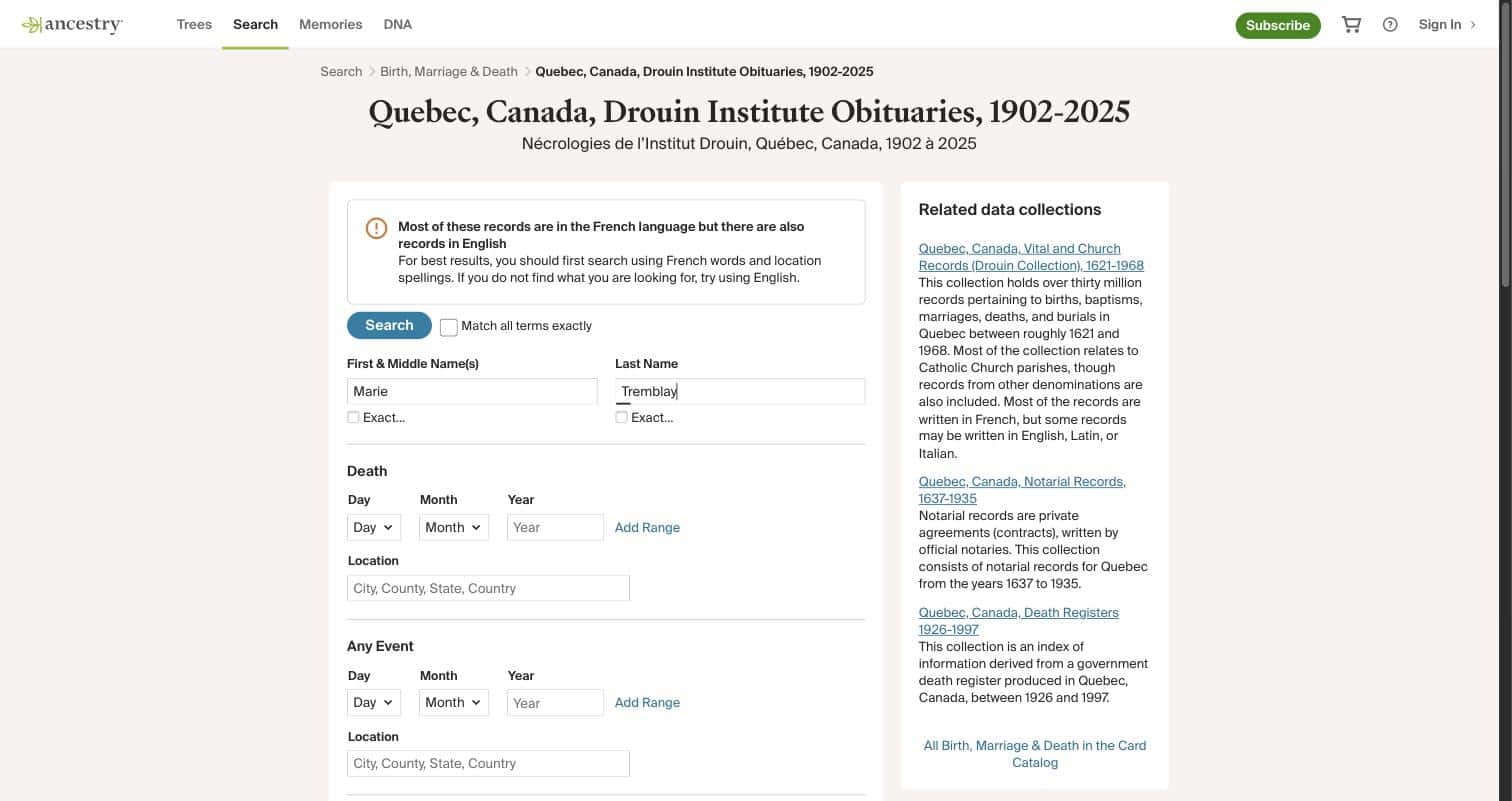
You'll see a list of matching names, with death dates and places blurred. That still tells you whether your ancestor appears in the index.
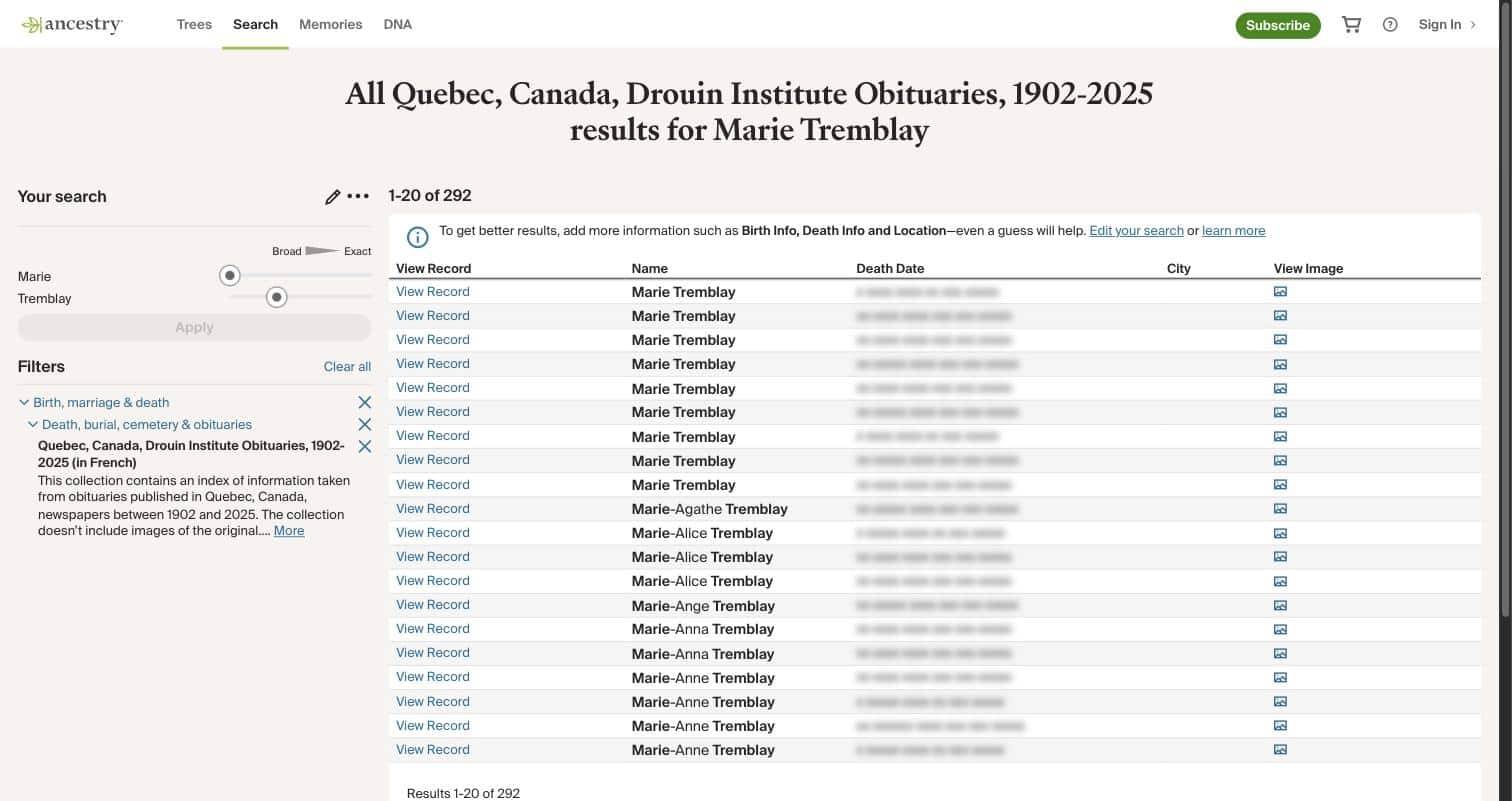
On Genealogy Quebec, use the main search page. Enter a name, then click "Obituaries, Headstones, Memorial Cards" under Collections.
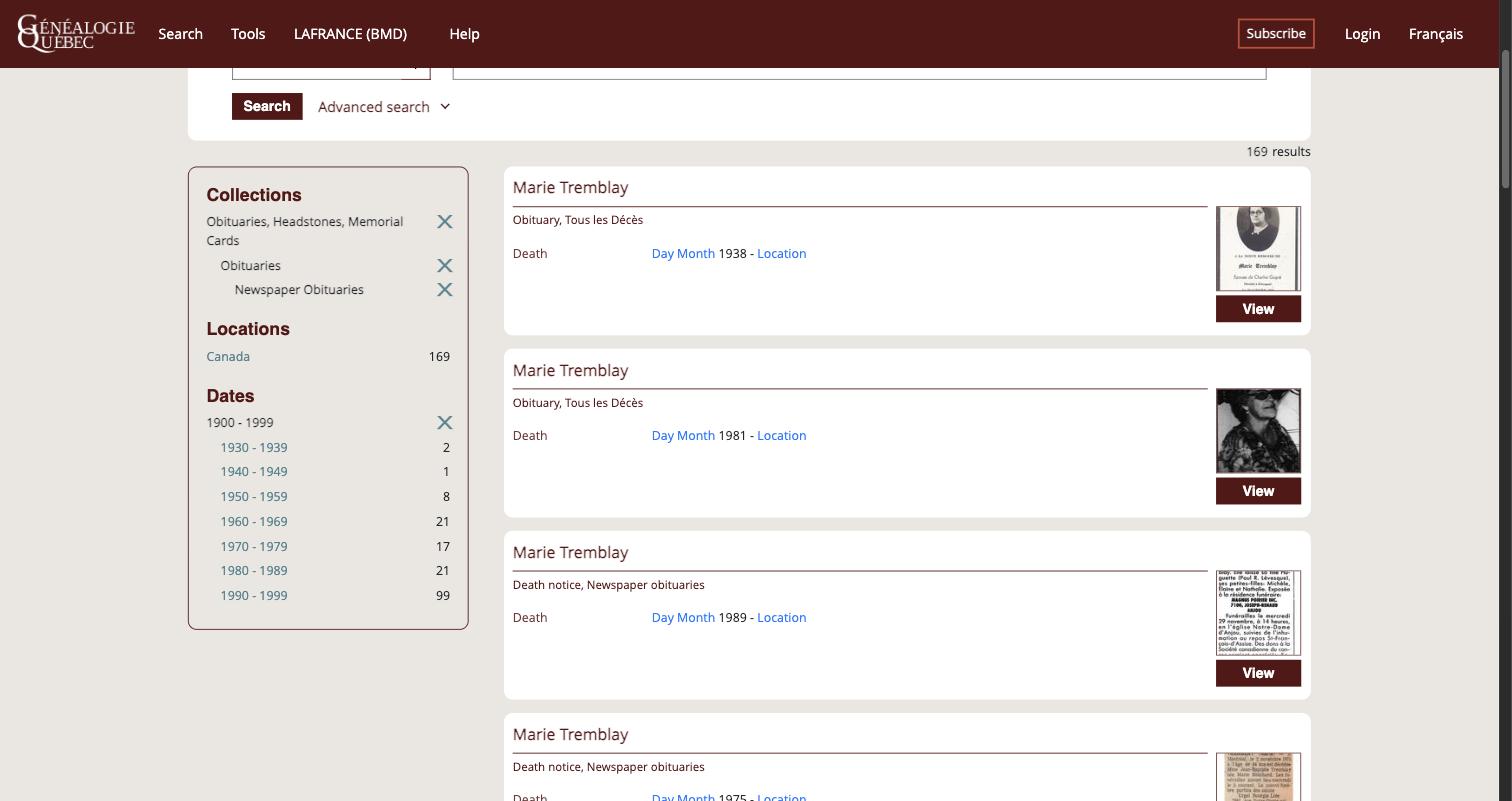
With a common surname, the free year of death can help you spot the right person.
To see a full record, both sites offer a free trial. Each requires a credit card and will convert to a paid plan unless you cancel.
A free search can confirm that a record exists and roughly when your ancestor died. It won't give you the birthplace or parents' names, which point to official records.
Before you order documents, CanadaVisa's citizenship by descent eligibility checker can show which generation your claim runs through.
Get a Free Consultation on Applying for Proof of Canadian Citizenship

- Do you need Canadian immigration assistance? Contact the Contact Cohen Immigration Law firm by completing our form
- Send us your feedback or your non-legal assistance questions by emailing us at media@canadavisa.com