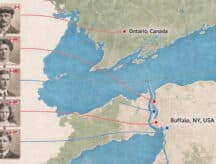
Tens of thousands of Canadians once lived in Buffalo. If one was your ancestor, you may have a claim to Canadian citizenship

In 1900, 17,242 people living in Buffalo had reported being born in Canada. That was one in every 20 residents of the city, according to the U.S. Census Office’s own tables.
Canadians were the third largest immigrant group at the time, with more born in Canada than in Ireland. Nearly twice as many were born in Canada as in England, Scotland and Wales combined. Only Germany and Poland had sent the city more people.
A Canadian law in force since December 2025 gives those numbers new meaning today. Anyone descended from one of Buffalo’s Canadian-born residents may already hold Canadian citizenship, whether their families remember the connection or not.
Get a Free Consultation on Applying for Proof of Canadian Citizenship
Why current counts of Buffalonians with Canadian ancestry are likely an undercount
Part of the answer is history. Randy William Widdis, a historical geographer at the University of Regina, has spent decades studying English Canadians who moved to the United States.
In his 1998 book, With Scarcely a Ripple, Widdis examines why historians largely overlooked this immigrant group. English Canadians spoke the same language as their American neighbors. Scholars assumed they blended in quickly and paid them little attention.
Part of it is the census form. The ancestry question prints sample answers to jog people’s memories, and “French Canadian” appears among them; however, “Canadian” does not.
The Census Bureau’s own researchers have flagged this kind of problem. Sample answers can raise reporting of the groups listed and lower it for groups left off. The Bureau also records only the first two ancestries a person writes down.
Ontario was a settler society too. Many of the Canadians who crossed into Buffalo had English, Scottish, Irish or German roots. As a result, their descendants may describe themselves by those older origins, rather than as Canadians.
Three signs your Buffalo family may have a claim
French Canadian families often carry a clue in their surname, as many do in northern New York. Names like Tremblay, Gagnon or Pelletier point straight to Quebec. Ontario families rarely leave that trail. Many carried English, Scottish or Irish surnames, so a family named Kelly from Ontario looks the same on paper as one that sailed straight from Cork.
Other records fill the gap.
- A Canadian birthplace on an old census page. U.S. censuses from 1880 to 1930 recorded each person’s birthplace and each parent’s birthplace. “Canada” beside an ancestor, or beside one of their parents, is the clearest early sign.
- A naturalization record. U.S. naturalization papers from 1906 onward record where each applicant was born.
- Family ties across the Niagara River. Relatives in Hamilton, St. Catharines or Toronto, or a family story about coming over from Canada, can point toward an Ontario line.
One sign is only a starting point. A claim needs a documented line to an ancestor who was born in Canada or naturalized there.
Free and paid research tools make those records searchable by name.
A law with no generational limit
Bill C-3 came into force on December 15, 2025.
Before that date, Canada cut off citizenship by descent after the first generation born outside the country. Citizenship by descent means inheriting citizenship through a parent or earlier ancestor, rather than through birth on Canadian soil.
Parliament removed that limit for anyone born before December 15, 2025, and applied the change back through the generations.
Now any individual with just one provable Canadian ancestor in their direct line of descent may hold Canadian citizenship themselves. They simply need to apply to the Canadian federal government to prove their status.
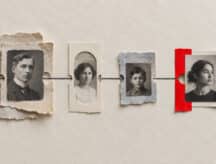
A proof of citizenship application is submitted for this purpose, with supporting documentation connecting each generation in a chain to each other.
Applicants face no language test, no residency requirement, and no oath. Both the United States and Canada permit dual citizenship, and claiming Canadian status adds no U.S. tax obligation.
How can I prove a line of descent?
An application traces the family one generation at a time, using birth, marriage, baptismal, and death records.
A Buffalo family’s Canadian ancestor will often have come from Ontario, across the Niagara River. Ontario splits its records between two offices. Civil registration there began in 1869, so an older birth may rest on a church record instead. CanadaVisa keeps a guide to requesting Ontario documents.
As of September 2026, Immigration, Refugees and Citizenship Canada (IRCC) quotes about 33 months to process an application.
Residents who want to see where their own family line stands can start with CanadaVisa’s citizenship by descent eligibility checker.
Methodology: 1900 figures come from Table 8a of the U.S. Census Bureau's Abstract of the Twelfth Census, which classifies the foreign-born population of large cities by country of birth. The table's Canada figure includes people born in Newfoundland, which did not join Canada until 1949.
Get a Free Consultation on Applying for Proof of Canadian Citizenship
- Do you need Canadian immigration assistance? Contact the Contact Cohen Immigration Law firm by completing our form
- Send us your feedback or your non-legal assistance questions by emailing us at media@canadavisa.com