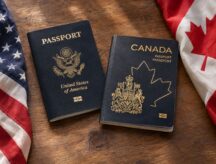
Canada is proposing another extension of its foreign homebuyers ban. But Americans with Canadian ancestry may be exempt

Canada's federal government wants to keep foreign buyers out of the country's existing homes for two more years.
Budget 2026, tabled on November 5, proposes extending the ban on foreign purchases of existing residential property to January 1, 2029, while opening newly built homes to foreign buyers.
But for a select group of Americans, this ban on foreign homebuyers does not apply. That is because they are also now Canadian citizens through their ancestry – even if they have not stepped foot or lived in Canada.
Get a Free Consultation on Applying for Proof of Canadian Citizenship
To qualify though, they must have a Canadian citizenship certificate, which they get by filing a proof of citizenship application package.
How Americans are side-stepping the foreign buyer ban
The Prohibition on the Purchase of Residential Property by Non-Canadians Act came into force on January 1, 2023.
It bars foreign commercial enterprises and anyone who is not a Canadian citizen or permanent resident from buying residential property inside a census metropolitan area (similar to a US metropolitan statistical area). Much of rural Canada and cottage country falls outside the ban, and there are limited exceptions for some temporary workers, refugee claimants and international students.
Budget 2026 proposes keeping existing and resale homes off-limits to foreign buyers until January 1, 2029, while lifting the ban on new residential properties. A foreign investor eyeing a resale condo in Toronto or Vancouver, for example, would stay blocked for two more years, but could buy a presale unit in the same city.
Canadian citizens face neither restriction. And since December 15, 2025, far more Americans count as Canadian citizens than before.
That is the day Bill C-3 took effect. The law eliminated the first-generation limit on citizenship by descent, which had cut off citizenship for children born abroad to Canadian parents who were themselves born abroad. People born outside Canada before December 15, 2025, through an unbroken line of Canadian citizens are now automatically Canadian, whether the Canadian link is a parent, a grandparent or an ancestor further back.
Because the ban covers only non-Canadians, a citizen by descent can legally buy a home anywhere in Canada, including a resale condo in downtown Toronto.
There is one catch. To prove their status as a Canadian citizen, Americans need a citizenship certificate, which means submitting a proof of citizenship application. As of October 2026, processing for this application type takes 34 months, although this is subject to change.
Ottawa could also extend the ban again, as it did in 2024. For Americans with Canadian roots who plan to buy in a Canadian city in the next few years, applying for proof of citizenship now is the safest way to avoid restrictions.
Trace your family lineage with the Family Line Explorer
Could you be a Canadian citizen by descent? Clues to look for
Many Americans with Canadian ancestry do not know it. A few signs are worth checking:
- A parent or grandparent born in Canada. This is the most direct route, and the easiest to document with birth records.
- French surnames. Having a French-Canadian surname signifies higher chance of French-Canadian ancestry. Some families also have names that got translated. For example, LeBlanc became White. Then there are families that dropped half of a two-part “dit” name. While these should not be seen as conclusive evidence of ancestry, it can point you in the right direction. CIC News has published a list of old French-Canadian surnames that could mean one is a secret Canadian.
- French-Canadian roots in New England or the Midwest. Between 1840 and 1930, close to a million French Canadians left Quebec for mill and lumber towns in states such as Maine, New Hampshire, Vermont, Massachusetts, Rhode Island and Michigan. Their descendants are among the Americans most likely to qualify.
- Quebec parish records or US naturalization papers. Baptism and marriage records from Catholic parishes in Quebec, or naturalization papers naming Canada as a country of origin, can help establish the link.
Here’s a look at some other clues that could hint towards Canadian ancestry.
Americans are already looking at Canadian property
American interest in Canadian property is running at record levels. Canadian real estate franchisor, Royal LePage, noted that interest from US-based users on their website repeatedly spiked during the first five months of 2026, usually correlating to major moments in America’s political scene.
According to the firm, the spikes often closely tracked turbulent news cycles or times of crisis. For example, there was a 125% week-over-week spike from US-originated sessions in the same week when escalating tensions surrounded the Iran ceasefire negotiations.
It is worth noting that some Canadian provinces charge a provincial tax on foreign or non-resident buyers.
| Jurisdiction | Tax | Rate | Where it applies | Does a citizen by descent living in the US pay it? |
| Ontario | Non-Resident Speculation Tax | 25% | Province-wide | No |
| Toronto | Municipal Non-Resident Speculation Tax | 10% (on top of Ontario’s) | City of Toronto | No |
| British Columbia | Additional Property Transfer Tax | 20% | Designated areas, including Metro Vancouver and the Fraser Valley | No |
| Nova Scotia | Non-resident Provincial Deed Transfer Tax | 10% | Province-wide | Yes, unless they move to Nova Scotia within six months |
The extension on the foreign homebuyer plan is in its proposal stage. The federal government has to propose legislation and launch a regulatory process for this change.
Wondering if you qualify as a Canadian citizen by descent through your ancestry? CanadaVisa has a citizenship by descent calculator to help you find out where you stand.
Get a Free Consultation on Applying for Proof of Canadian Citizenship

- Do you need Canadian immigration assistance? Contact the Contact Cohen Immigration Law firm by completing our form
- Send us your feedback or your non-legal assistance questions by emailing us at media@canadavisa.com