
Somewhere between the turkey and the pie this Thursday, your cousin decided to drop the news: they are a Canadian citizen by descent, and they have the paperwork to prove it.
If this happens, their claim most likely rests on Bill C-3, which took effect on December 15, 2025. The law scrapped the first-generation limit, the rule that stopped Canadian citizenship from passing past the first generation born abroad. Most people born outside Canada before that date, through an unbroken family chain, became Canadian citizens automatically.
That might lead you to wonder: if your cousin is Canadian, are you too? The answer depends on one thing: which ancestor made them Canadian, and whether that person sits on your family tree too.
Get a Free Consultation on Applying for Proof of Canadian Citizenship
What your cousin’s news means for you
Your cousin’s citizenship does not automatically mean you are a Canadian citizen by descent too. Each person’s claim stands on their own line of descent, and IRCC assesses every applicant individually.
Their news may be a meaningful lead for you, however. First cousins share at least one set of grandparents. If your cousin’s Canadian ancestor is one of those shared relatives, there is a very good chance the line runs down to you.
Canadian citizenship by descent only travels in a direct line, from parent to child. Your direct line is your parents, your grandparents, your great-grandparents and so on up the tree. Aunts, uncles and cousins sit beside that line, not on it, so their citizenship cannot pass sideways to you. What matters is whether the ancestor who made your cousin Canadian is also one of your direct ancestors.
How far back that shared ancestor sits depends on the kind of cousin you are talking to.
First cousins. Your parents are siblings, so you share a set of grandparents. If your cousin’s claim runs through one of those grandparents, or anyone above them in that grandparent’s line, it may run through you too.
Second cousins. Your grandparents were siblings, so the closest ancestors you share are great-grandparents. Your cousin’s claim has to run through one of those great-grandparents, or someone further up. Your families split a generation earlier, so you will have more links of your own to document.
A shared ancestor only covers the generations you and your cousin have in common. Below the point where your families branch apart, each side has to show its own unbroken chain of Canadian parents.
How two cousins can share one Canadian claim
Take a fictional family. Henri Gagnon was born in Montreal in 1901 and later moved to Massachusetts, where his daughter Rose was born in 1928. Henri was still a Canadian citizen when Rose was born, so Rose was Canadian by descent.
Rose had two children, Linda and Michael. Linda is your mother. Michael is your cousin’s father.

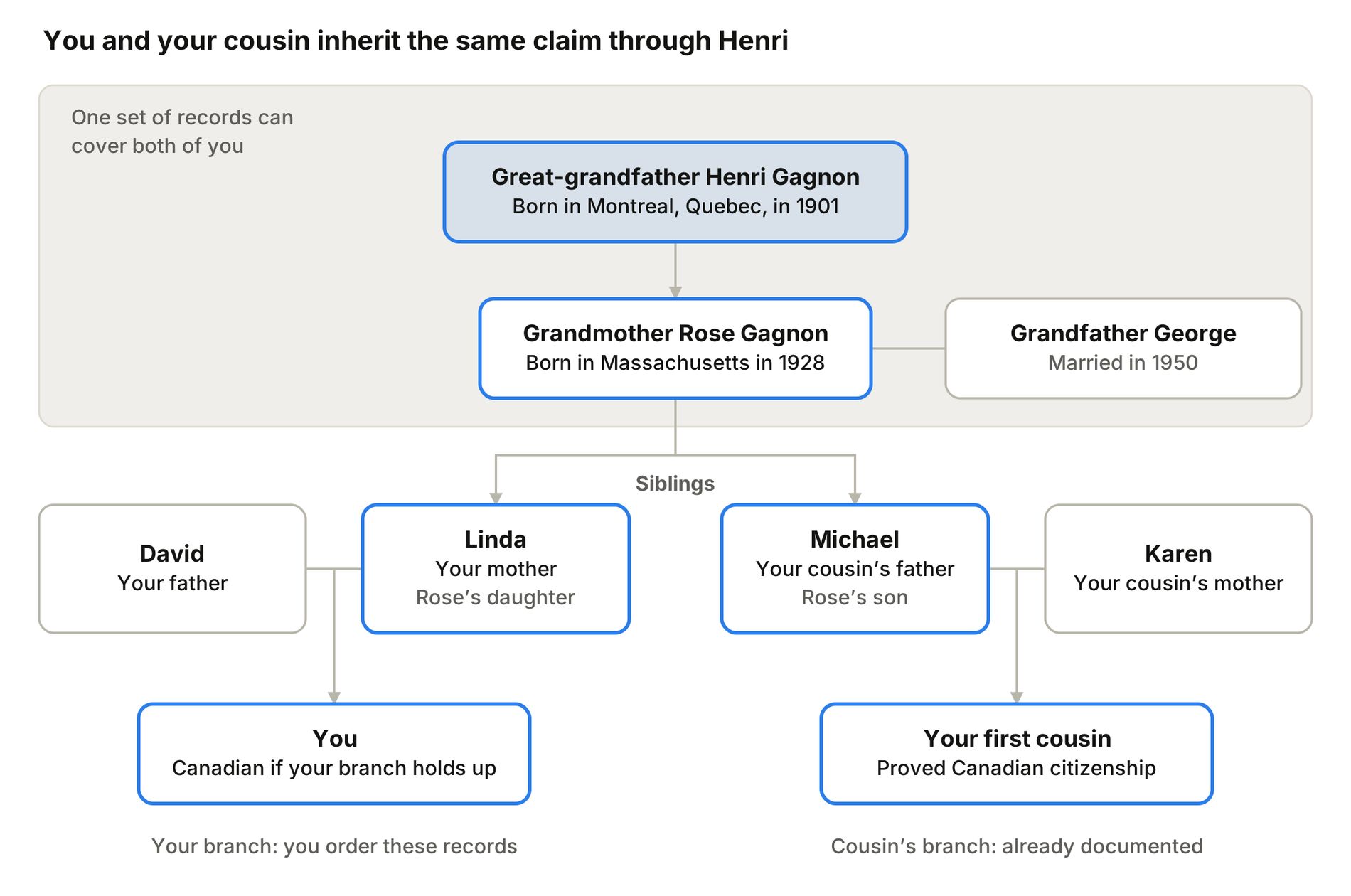
If your cousin is a Canadian citizen by descent, you may be too if the claim runs through a common ancestor
Your cousin proved the Canadian lineage running from Henri to Rose to Michael to themselves. Your chain runs from Henri to Rose to Linda to you. The top two links are identical, so the records your cousin gathered for Henri and Rose can serve your application too.
Your branch still needs its own proof. You will need your mother’s (Linda) long form birth certificate, connecting her to grandmother Rose, your own, and any marriage records that explain a change of surname along the way. If IRCC found a problem on the shared stretch of your cousin’s file, expect the same problem on yours.
Get a Free Consultation on Applying for Proof of Canadian Citizenship
When your cousin’s claim does not carry over to you
First cousins share one set of grandparents. Your cousin has a second set of grandparents on the side of the parent who married into your family, and you have no blood tie to them.
Say your uncle married a woman whose father was born in Nova Scotia. Your cousin can claim Canadian citizenship through that grandfather. You cannot, because he is your aunt’s father, not your ancestor.
The same applies to in-laws. A Canadian line only passes from parent to child, by birth or by adoption.
This does not rule you out. Your cousin’s news may simply be the push to look at your own grandparents, great-grandparents and the generations above them.
Five questions to ask your cousin this Thanksgiving
A shared ancestor is the first step. Your cousin may have spent months on the research you are about to start, so here are some questions to ask your relative before you order a single record.
1. Which ancestor is your claim based on?
Get a full name, a birth date and a birthplace. With those three details you can place the ancestor on your tree and see whether your branches meet.
2. How did that ancestor become Canadian, and when?
An ancestor born in Canada is the simplest case. An ancestor who moved to Canada and naturalized there also counts, but the dates matter: each person in the chain needs to have been Canadian before their own child in the line was born.
3. Which documents have you found, and where did they come from?
For the generations you share, your cousin has already done the digging. They know which archive, parish or vital records office holds the birth and marriage records, and you can order your own certified copies from the same place. That can save you weeks.
4. How far along are you in the process?
Your cousin may still be gathering records, may have submitted a proof of citizenship application to the Canadian government, or may already hold a Canadian citizenship certificate. Each stage tells you something about what lies ahead. Ask how long each step took and whether IRCC asked them for anything extra.
5. Did anything trip you up?
Name changes, misspelled surnames, a missing baptism record: whatever slowed your cousin down will probably slow you down too, if the problem sits on your shared stretch of the tree. Claims through female ancestors often need extra marriage records, for example. Ask also whether they worked with a lawyer, and what that person flagged.
If you qualify, your biological siblings probably do too
A claim that reaches you through a shared ancestor also reaches your brothers and sisters, as long as they share the same parent the line runs through. A half-sibling on your other parent’s side would not qualify through this line.
The December 15, 2025 date matters here. Siblings born before it fall under the same rules as you. A child born abroad on or after that date, in the second generation or later, only becomes Canadian if their Canadian parent spent at least 1,095 days in Canada before the birth.
That means one family member’s findings can open the door for a whole branch of your family. You, your siblings and your cousins can do a quick pre-dinner eligibility check and split the cost of ordering records going forward.
This Thanksgiving, a conversation with relatives over turkey could be the start of your dual Canadian-US citizenship, and a second passport. If your cousin’s story sounds like yours, CanadaVisa’s citizenship by descent eligibility checker can help you check where you stand.
Get a Free Consultation on Applying for Proof of Canadian Citizenship