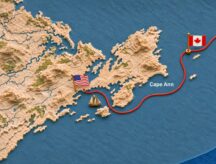
Generations of residents in Gloucester, Massachusetts may be Canadian citizens thanks to a new law

Massachusetts is full of families with Canadian roots, but Gloucester’s roots run deeper still. In 1930, nearly 3 in 10 people in the city were born in Canada or had a parent who was.
If one person in your direct family line was Canadian, you may already be a Canadian citizen too. Under the law, you don’t become Canadian by applying. You already are. Applying for proof of Canadian citizenship gets you the document that confirms it. With that document, you can apply for a Canadian passport and avail of all the benefits that come with being a Canadian citizen.
Get a Free Consultation on Applying for Proof of Canadian Citizenship
Your odds grow with every generation you trace. Go back six generations, and you have 64 great-great-great-great-grandparents. Only one of them needs to be Canadian for your claim to work.
What the law says
Canada changed its citizenship law on December 15, 2025. Bill C-3 removed the rule that stopped citizenship by descent after one generation born abroad.
If you were born before that date, an unbroken direct line to a Canadian ancestor may make you Canadian already. A direct line runs from you to your parent, to their parent and so on. A Canadian aunt, uncle or great-uncle doesn’t count. It doesn’t matter how many generations back the Canadian ancestor lived.
Think this might be you? Jump to how to check.
Many Gloucester families trace back to ancestors who left Canada before 1947, the year Canadian citizenship began. The law covers most of them. Someone born in Canada before January 1, 1947, who later became American, counts as Canadian under the Citizenship Act. Newfoundland joined Canada later, so its cutoff is April 1, 1949.
This matters in a fishing town. Plenty of Gloucester’s Canadian-born fishermen died at sea long before 1947. Their deaths don’t end the claim. The law asks whether that ancestor would have qualified if Canada’s citizenship law had existed before they died. If the answer is yes, the line continues to you. CIC News has explained how this works for Americans whose Canadian ancestors died before 1947.
Canada and the US both allow dual citizenship, so you keep your American citizenship.
You won’t face a language test, a citizenship test, an interview, a ceremony or an oath. You don’t have to live in Canada either. Instead of applying as a newcomer would, you apply for a certificate that proves the status you already hold.
Why do so many Gloucester families qualify?
Gloucester has a long history of Canadian immigration. The city began hiring Newfoundland fishermen as early as 1648. The first recorded Nova Scotian arrived around 1828, aboard a fishing schooner captained by Elisha Oakes.
Maritimers came for well-equipped vessels and prompt cash pay. A skilled man could soon command a ship of his own. In 1875, Gloucester’s customs collector, Fitz J. Babson, described a large wave of young, single men “from the Provinces.” He wrote that they made up much of the town’s fishing crews.
By 1880, thousands had followed. Gloucester was home to 2,383 Nova Scotians, 110 New Brunswickers and 195 Prince Edward Islanders. About one in seven residents had been born in the Maritimes. Today, the city’s Fishermen’s Memorial lists 5,384 fishermen lost at sea.
Many of those families stayed, and their children grew up as Americans. The same pattern played out across Massachusetts. In Boston, people born in English-speaking Canada were the city’s second-largest immigrant group by 1920.
How many Gloucester residents may qualify for Canadian citizenship?
CIC News estimates that between 9,700 and 14,600 Gloucester residents may have a qualifying Canadian ancestor. That’s roughly one in three to one in two of the city’s 28,500 US citizens.
These figures are scenarios built on stated assumptions, not a head count. We assumed the Massachusetts-born residents we counted have family roots in the area going back to 1930. If fewer of them do, the figure could be as low as about 4,500.
The estimate starts from the 1930 census. That year, the census counted about 7,160 Gloucester residents born in Canada or Newfoundland, or to a parent from there. That was nearly 3 in 10 residents. Across Essex County, the share was about one in five.
Today, only about 1,040 Gloucester residents tell the US Census Bureau they have Canadian or French-Canadian ancestry. However, ancestry figures like this often undercount Canadian roots. They rely on what people report about themselves, and the census records at most two ancestries per person. A Gloucester family might list Irish and Italian and leave out a Nova Scotian great-grandfather.
Under the Citizenship Act, that one great-grandfather is enough. Our estimate counts family lines back to the 1930 census instead of self-reported ancestry. That’s why it runs much higher. Our full methodology appears at the end of this article.
Trace your family lineage with the Family Line Explorer
How to check if you qualify for Canadian citizenship by descent
If your family has been on Cape Ann for generations, you can look for these clues to a possible Canadian ancestor:
- An ancestor lost at sea, or a name you recognize on the Fishermen’s Memorial
- Family members who crewed Gloucester schooners between the 1850s and 1920s
- Relatives from Nova Scotia, Cape Breton, New Brunswick, Prince Edward Island or Newfoundland
- A family story about coming “from away,” or from “the Provinces”
In addition to the above, the following clues apply to families anywhere in New England:
- A parent, grandparent, great-grandparent or great-great-grandparent born in Canada before 1947, or in Newfoundland before April 1, 1949
- A French-Canadian or Acadian surname, even one anglicized over time
- An “Irish” or “Scottish” family history that passes through a Canadian port
- Relatives from Halifax, Saint John, Charlottetown, St. John’s or Quebec
CanadaVisa’s Family Line Explorer traces your line from a Canadian ancestor to you and lists the records you’d need. The citizenship by descent calculator shows which generation your claim runs through.
Most ancestors who left before 1947 qualify, but not all. A small number made a formal “declaration of alienage” before 1947, and that declaration can break the chain.
Where to start the search on Cape Ann
The slowest part of most applications is collecting documents that link each generation to your Canadian ancestor. Cape Ann has strong local records to start with:
- Sawyer Free Library, 2 Dale Ave., Gloucester. Its local history librarian takes research appointments. The library holds the City Archives’ Lost at Sea Register and Gloucester passenger lists from 1820 to 1870. It also has Gloucester Daily Times birth, marriage and death notices from 1827 to 1998. City directories from 1860 to 1993 and Gloucester vital records from 1851 to 1911 round out the collection.
- Cape Ann Museum Library & Archives, 27 Pleasant St., Gloucester. It opens Tuesday to Saturday, 10 a.m. to 4:30 p.m. Its collections include business records, cargo manifests, and more than 15,000 historic photographs. Email library@capeannmuseum.org before you visit so staff can pull off-site material.
- Gloucester City Archives, City Hall. It keeps the city’s municipal records, some older than the town’s 1642 incorporation.
- Massachusetts Archives, 220 Morrissey Blvd., Boston. It holds state birth, marriage and death records from 1841 to 1935.
- Registry of Vital Records and Statistics, 150 Mount Vernon St., Dorchester. It holds Massachusetts records from 1936 onward.
Canada’s immigration department, Immigration, Refugees and Citizenship Canada (IRCC), requires documents from the original issuing authority. For your ancestor’s Canadian birth record, you’ll need the vital statistics office of their home province. CanadaVisa lists the documents you need and where to find them.
One ancestor, a whole family
If you’re Canadian through an ancestor, so is everyone else with an unbroken direct line to that same ancestor. That includes your siblings and your first cousins who share the same ancestor. It also includes their children and anyone else descended from that ancestor. In a city where families have fished together for generations, one person’s research can support applications across a whole family.
One limit applies to children born on or after December 15, 2025. A child born outside Canada to a Canadian parent who was also born outside Canada isn’t automatically Canadian. That parent first needs 1,095 days of physical presence in Canada before the birth. CIC News has covered options for families affected by this rule.
Methodology: how we derived our estimate
We counted people in the city of Gloucester. The American Community Survey (ACS) for 2020 to 2024 puts its population at about 30,000. About 28,500 of them are US citizens.
Step 1: Count the Canadians in 1930. In 1930, 24,204 people lived in Gloucester. The US census that year counted about 7,160 of Canadian origin. Some were born in Canada or Newfoundland. The rest were born in the US to a parent from there. That’s nearly 3 in 10 people. The census recorded birthplace, not citizenship. Two figures in the scanned tables are hard to read, but either reading keeps the share at 29% to 30%.
Step 2: Count the family lines. Most people with deep roots here trace back to that 1930 population. How far back depends on their age. Generations in the US have run about 25 years apart. In 1970, the average mother was 24.6 when she gave birth. People born around 1960 had grandparents alive in 1930. People born around 1985 had great-grandparents alive then. Everyone has two sets of grandparents and four sets of great-grandparents. So we counted two to four family lines back to 1930. Gloucester’s typical resident is 50, older than in greater Boston, so the lower end fits more residents. We count each couple as one line, not two, to allow for Canadians marrying each other. That’s an assumption, not a measured rate.
Step 3: Work out the odds. Each family line had nearly a 3 in 10 chance of being Canadian. With two lines, the chance that at least one is Canadian is about 50%. With four lines, it’s about 75%.
Step 4: Apply the odds to people with local roots. We applied those odds to 19,318 Massachusetts-born Gloucester residents. We chose this group because it most closely matches the people the 1930 tables counted. Those tables covered white residents only. The closest match in today’s census is residents who identify as white and not Hispanic. This was a practical choice, made because the data allowed nothing more precise. It says nothing about who qualifies. Anyone with a qualifying Canadian ancestor may be a citizen, whatever their background. We assumed everyone in this group has local roots going back to 1930. That share hasn’t been measured.
The result. Two family lines gives about 9,700 people. Four family lines gives about 14,600. That’s roughly one in three to one in two of the city’s 28,500 US citizens.
Testing the assumptions. We tested two weak points, alone and together:
- Fewer local roots. With only 60% of the Step 4 group rooted locally, the range falls to about 5,800 to 8,700.
- Roots elsewhere in the county. Some Massachusetts-born residents trace back to other towns, where Canadians were less common. Using Essex County’s 1930 rate of about one in five gives about 7,500 to 12,100.
- Both together. The range falls to about 4,500 to 7,200.
Who our count leaves out. Several groups aren’t in our count because the data don’t let us estimate them. Their claims are no weaker. Because the 1930 tables counted only white residents, they missed Black Canadians. That includes families from Nova Scotia’s Black communities, which date back at least to the 1780s. Our count also leaves out residents who identify as non-white or Hispanic. Some have Canadian ancestors through mixed families. It leaves out people with Canadian roots born in other states, and the US-born children of recent Canadian immigrants. Each of these groups would push the number up if we could count them. So would the extra family lines some younger residents have.
What could lower the number. Gloucester’s Italian and Portuguese communities often married within their own groups. That makes family lines less independent than our method assumes. Canadian families may also have had fewer children or moved away more often. We haven’t measured whether these effects outweigh the groups we couldn’t count.
What the number doesn’t mean. It counts people who may have a qualifying Canadian ancestor. It doesn’t count people who have proven their citizenship. Each claim needs documents for every generation, and IRCC makes the final decision.
A comparison. About 1,040 Gloucester residents tell the Census Bureau they have Canadian or French-Canadian ancestry. That counts what people report. Our estimate counts family lines, so the two figures aren’t directly comparable.
Sources: US Census Bureau, 1930 Census, Vol. III, Massachusetts, Tables 15, 18 and 19; American Community Survey 2020–2024 five-year estimates, Tables B01002, B01003, B04006, B05002 and B06004H; National Center for Health Statistics, National Vital Statistics Reports, Vol. 51, No. 1, Table 1; Alan A. Brookes, “Out-Migration from the Maritime Provinces, 1860-1900,” Acadiensis, 1976; G. Brown Goode, The Fisheries and Fishery Industries of the United States, 1887; Epes W. Merchant, Gloucester fishing history.
Get a Free Consultation on Applying for Proof of Canadian Citizenship

- Do you need Canadian immigration assistance? Contact the Contact Cohen Immigration Law firm by completing our form
- Send us your feedback or your non-legal assistance questions by emailing us at media@canadavisa.com