30 minutes, 30 new Canadians: how one man used a chatbot to uncover his family’s citizenship

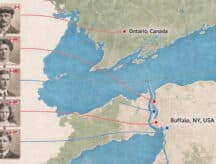
When Larry was born in 1955, it was four years too late to meet his great-grandfather, Pierre Jean-Baptiste Robichaud, a native of Moncton, New Brunswick who had settled in Michigan and been laid to rest in a Lansing cemetery.*
The family had no way of knowing that in 2026, Larry and his children could all claim the right to Canadian citizenship from Pierre’s family line.
Schedule a Free Canadian Citizenship Consultation
A 30 year veteran of Oracle, Larry had settled into a comfortable semi-retirement in Raleigh, North Carolina, where he and his wife lived within a few hours' drive of each of their three their adult children.
Then came the winter of 2025–2026, the ICE raids, the protests, the shootings. Keith Porter. Renee Good. Alex Pretti. Tense, harrowing moments for a mixed race family with children adopted from Nigeria.
Larry’s daughter, a paramedic, had often spoken about moving to Canada, but the competitive process for obtaining Canadian permanent residency—a cage match among 230,000 highly skilled professionals—was a real barrier to permanent relocation.
Then Larry’s wife read an article about recent changes to Canada’s citizenship laws, and everything changed.
If the family could prove a direct line of descent from a Canadian ancestor, Larry and hid children could claim their right to Canadian citizenship, and Larry could sponsor his wife for permanent residence. But where should they begin to look? Did the records even exist? If so, where were they?
Armed with only his great-grandfather’s name and place of origin, Larry started with Google Gemini.
Gemini led Larry to Canada’s digitized census records, available online through Library and Archives Canada.
Within a few minutes of browsing, Larry had found it. He stared, transfixed at his monitor, at a grainy page of hand-written names from Canada’s 1901 census. The legibility left something to be desired, but he found the name he was looking for: Pierre Jean-Baptiste Robichaud. Nationality: Canadian. Profession: Grocer.
Here it was: confirmation that Larry and his children didn’t need to immigrate to Canada. Through their descent from Pierre, they were already citizens. With the right documents, they could apply for proof of Canadian citizenship.
Larry messaged his family group chat, and it started blowing up. There were over 30 family members descended from Pierre. Every single one of them a Canadian citizen by descent.
Schedule a Free Canadian Citizenship Consultation
Over the next few days, plans began to fall into place. Larry did research on which documents were needed, and found the archives from which to request copies of Pierre’s and Pierre’s daughter’s baptismal records.
His wife went to working on finding a representative to handle their proof of citizenship applications, and his daughter looked up cities they could live in along with the pay rates and the process for applying to work in local paramedic unions.
Online, Larry saw that it would likely take around 10 months for their proof of citizenship applications to be processed, but the plans for the move came together in just a few weeks.
It was decided: they were moving to Mississauga, Ontario.
Using AI for citizenship by descent research
As an experienced chatbot user, Larry was able to find what he was looking for quickly and efficiently
Here are some tips to get started with for your own AI-assisted citizenship search.
Give context: Chatbots can respond with much more useful information when your prompt includes details on why you’re asking what you’re asking. “How can I tell if I’m a Canadian citizen?” is less likely to be helpful than “I’m an American wondering if I may be a Canadian citizen by descent under Canada’s new citizenship laws. What are the best sources I should look at to determine that?”
Be specific: Rather than “where should I look up Canadian citizenship records?” write, “What are the best places for me to find Canadian citizenship records for Jacques Riviere born in 1892 who lived in Quebec City in the 1920s?”
Look for sources: Rather than expecting you’ll be able to get every piece of info you need directly in the chatbot window, plan on finding where you need to go. When information is more obscure, chatbots are more likely to be able to correctly identify the needed sources, and less likely to hallucinate incorrect responses.
Validate sources: Double check everything yourself in the original sources. Chatbots make mistakes. The last thing you want is to move forward excitedly with plans based on incorrect information. Viewing primary sources yourself can give you the peace of mind needed to proceed with confidence.
*Larry’s story reflects the real-life story of a tech worker retiree with racialized children adopted from overseas who used Gemini to discover his family’s Canadian ancestry in 30 minutes. Some details have been changed to protect client confidentiality and to provide narrative continuity.
Schedule a Free Canadian Citizenship Consultation
- Do you need Canadian immigration assistance? Contact the Contact Cohen Immigration Law firm by completing our form
- Send us your feedback or your non-legal assistance questions by emailing us at media@canadavisa.com