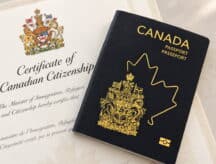
Lewiston, Maine was built by French Canadians—many of their descendants may now be Canadian too

In the 1870s, the trains pulled into Lewiston's Grand Trunk Station carrying a new kind of arrival.
They came from Quebec farms and Acadian villages in the Maritimes — thousands of French-speaking Canadians, drawn south by the steady wages of Maine's textile mills. They settled in a dense neighborhood beside the Androscoggin River, between the water and Lisbon Street. They called it Little Canada.
A century and a half later, their descendants are still here. And a recent change to Canadian law has turned that heritage into something many of them never expected: a possible claim to Canadian citizenship.
Get a Free Consultation on Applying for Proof of Canadian Citizenship
The University of Southern Maine's Franco-American Collection describes Lewiston as a city of roughly 60% French-Canadian ancestry*.
Against the city's current population, that points to something like 23,000 residents with French-Canadian roots — a rough figure, but a telling one for a city this size.
Many of those residents may already be Canadian citizens without knowing it.
That's because of Bill C-3, which came into force on December 15, 2025. The law removed the old first-generation limit on Canadian citizenship by descent. Now, in most cases, a person born outside Canada before that date who can trace an unbroken line to a Canadian ancestor may already be a citizen.
To know for certain, they have to apply for a citizenship certificate to confirm it.
Why the real number is likely higher
That 60% figure, however it's measured, likely undercounts the people with a Canadian ancestor in their line.
Heritage data depends on what people report about themselves. And over four or five generations, a lot gets lost.
For example, family names changed drastically over the years. Across New England, French-Canadian families anglicized as they assimilated: Leblanc became White. Charpentier became Carpenter. La Rivière became Rivers. A family that has gone by an English name for a century may not think of itself as French-Canadian at all.
None of that erases the ancestor. It just hides them. The Quebec-born great-grandfather is still in the family tree — waiting in a record somewhere for someone to go looking.
The only way to know is to trace the line back.
You can check where your family line stands using CanadaVisa’s citizenship by descent eligibility checker.
How Lewiston became a French-Canadian city
Lewiston's French story is one of the most concentrated in the United States.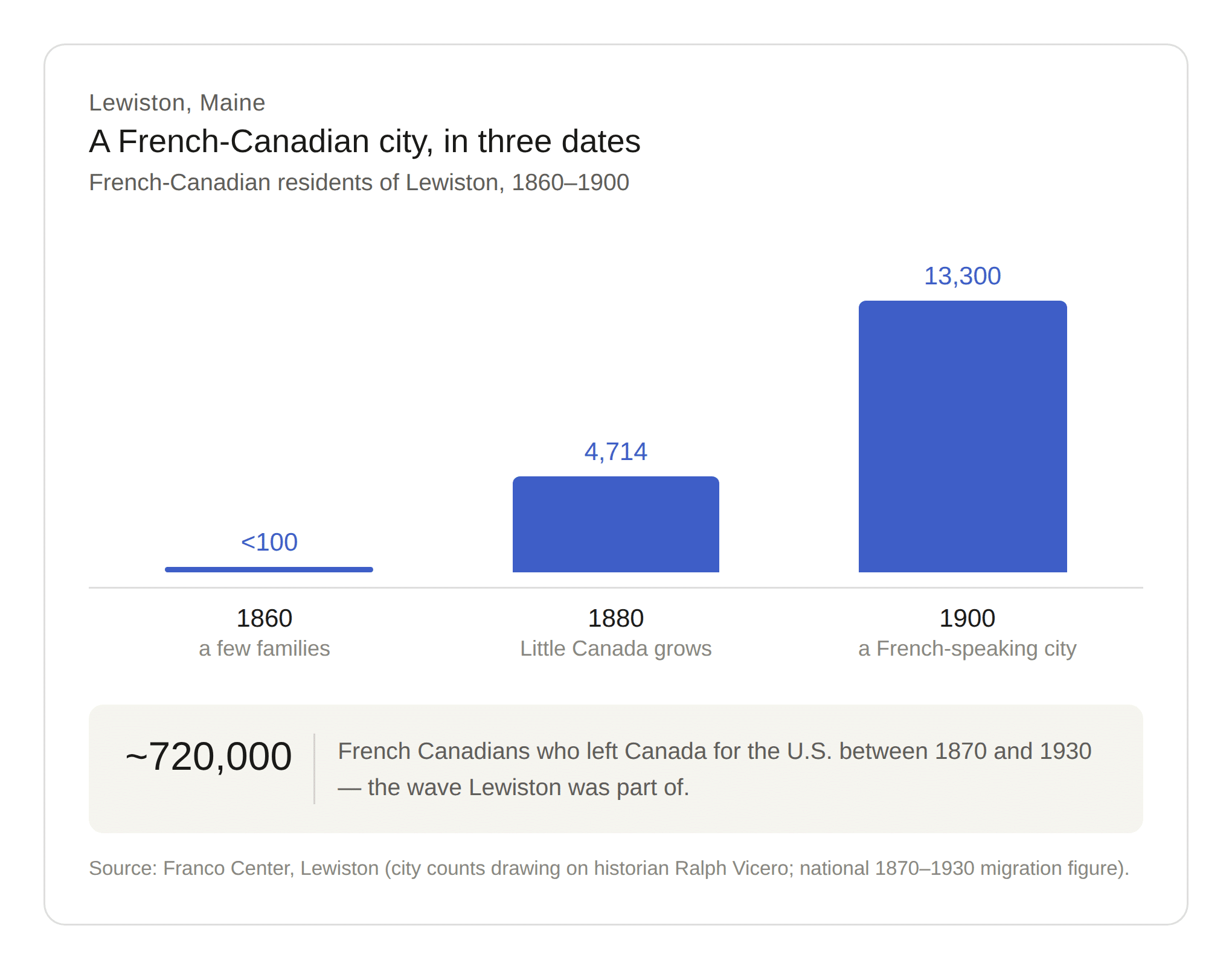
Between 1870 and 1930, roughly 720,000 French Canadians left Canada for the United States, according to the Franco Centre, Lewiston's centre for Franco-American heritage. Many were leaving a struggling Quebec economy where good farmland had grown scarce. Maine's mills offered work, and the railways made the journey easy.
Lewiston's French-Canadian population grew fast. The Franco Center, drawing on the work of historian Ralph Vicew, counts fewer than 100 French Canadians in the city in 1860. By 1880, there were 4,714. By 1900, the figure had reached 13,300.
They were not all from the same place. Lewiston's mill workers came from two distinct French-speaking worlds: French Canadians from Quebec, and Acadians from New Brunswick and the broader Maritimes — descendants of the original French settlers of Atlantic Canada. Both communities put down roots in the city, and both threaded their way into its family lines.
In Little Canada, they built a world that could sustain itself. French-language parishes. Catholic schools. The newspaper Le Messager, which ran for decades. For generations, you could live much of your life in Lewiston in French.
That density is why the city matters to this story. Few places in America drew French-Canadian and Acadian settlement so heavily or held onto it so long.
What this means for Lewiston residents
A Lewiston resident who descends from a Canadian ancestor may already hold Canadian citizenship under the new law. However, they will still be required to apply to prove their citizenship to obtain a Canadian passport.
To confirm their status, a person applies for a citizenship certificate — the official document Canada's citizenship department uses to recognize a citizen. A citizenship certificate is an official status document, and serves as proof of citizenship that lets a person apply for a Canadian passport.
The application has to show a continuous chain of descent from a Canadian ancestor, with documents for each generation in between — usually birth certificates, marriage certificates, and baptismal records.
Because most Lewiston applicants will trace their line to Quebec, many will need records from the province. Quebec birth and marriage records are issued by the Directeur de l'état civil, the provincial registrar.
A person can prepare the application themselves or hire a representative authorized by the Canadian government, such as a Canadian immigration lawyer, to handle it. Processing time for a citizenship certificate is currently 15 months.
[Get a Free Consultation on Applying for Proof of Canadian Citizenship]
Where Lewiston residents can start
Lewiston residents are in a strong position to begin their research in their home city.
The Lewiston Public Library holds city directories going back to 1883, along with cemetery, marriage, baptism, and naturalization records — and a complete microfilm run of Le Messager.
The Maine Franco-American Genealogical Society keeps Quebec parish marriage abstracts, Acadian and Maritime records, and Maine obituaries tied to French-Canadian families.
Lastly, the University of Southern Maine's Franco-American Collection focuses specifically on Lewiston-Auburn's French-Canadian history.
These collections are a strong place to find a lead. One caveat worth knowing: genealogy libraries can help you locate a record, but the official civil documents an application needs must come from the government authority that holds them.
The further back you can follow your family, the better your chances of finding the Canadian ancestor who changes everything.
Get a Free Consultation on Applying for Proof of Canadian Citizenship
*Methodology: The estimate of roughly 23,000 residents applies the University of Southern Maine Franco-American Collection's description of Lewiston as a city of about 60% French-Canadian ancestry to Lewiston's 2024 American Community Survey five-year population of 38,324.
The 60% figure is an undated institutional heritage description, not a current U.S. Census measurement. It is used here only as an illustrative proxy for the scale of the city's French-Canadian heritage. Ancestry is self-reported and is not the same as citizenship or a documented chain of descent; because many families anglicized their names or no longer identify as French-Canadian, the true number of residents with a Canadian ancestor may be higher. This is a heritage estimate, not a count of confirmed citizens or eligible applicants.

- Do you need Canadian immigration assistance? Contact the Contact Cohen Immigration Law firm by completing our form
- Send us your feedback or your non-legal assistance questions by emailing us at media@canadavisa.com