
Applying for proof of Canadian citizenship from abroad? A representative in Canada could save you months

Citizenship by descent applicants who live outside Canada and the United States can avoid several months of additional waiting by having a representative in Canada file their proof of citizenship application.
A representative is a person you authorize to deal with Immigration, Refugees and Citizenship Canada (IRCC) for you. Representatives can be paid or unpaid, and a relative or friend in Canada can take on the role for free. You’ll find details on both routes further down.
IRCC tells applicants abroad* to add three to four months to its posted processing time. Those extra months cover mailing and come in addition to the posted wait for a citizenship certificate, the document that proves you’re a Canadian citizen.
Get a Free Consultation on Applying for Proof of Canadian Citizenship
That wait now sits at close to three years.
*Abroad in this context means outside Canada and the US.
Why your application takes longer from abroad
Most people claiming citizenship by descent have to apply on paper. IRCC’s online application only covers a narrow group of applicants, such as people whose Canadian parent was born in Canada on or after February 15, 1977.
If you live in Canada or the US, in most cases, you mail your paper application to IRCC’s Case Processing Centre in Sydney, Nova Scotia.
If you live anywhere else, IRCC tells you to mail it to the Canadian embassy, high commission, or consulate that serves your area. Staff there forward it to IRCC in Canada.
Notably, your application processing starts the day IRCC receives your complete application in Canada. The added months your file spends in transit don’t count toward it.
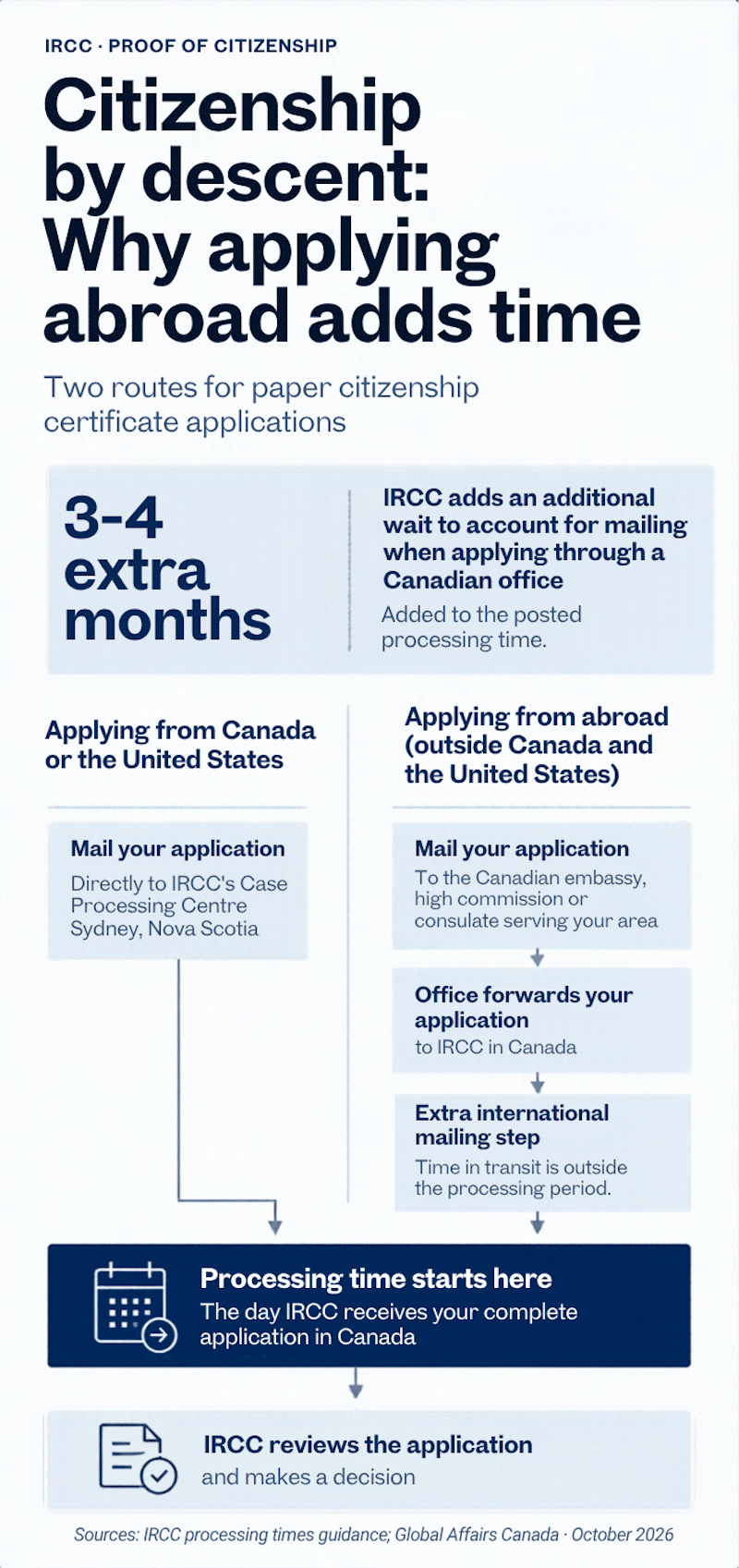
Global Affairs Canada also lists what its offices abroad won’t do. They don’t check your application for completeness or verify your documents. They won’t confirm they received your file, and they can’t give you status updates.
Your first word from IRCC is an acknowledgement of receipt (AOR), a letter confirming your file has entered processing, which, for applicants who applied on paper, may take several months to arrive.
Hiring a representative in Canada closes the gap
A representative based in Canada can mail your paper application to the Case Processing Centre in Sydney, Nova Scotia. Your file skips the embassy and the international mail route that comes with it.
A representative can’t speed up IRCC’s review of your file. IRCC states on its representative form that using one brings no special attention or faster processing.
Your total wait also depends on the officer who handles your file, and it can run past the posted time. The mailing months are the part you control.
The free route: family or a friend in Canada
You don’t have to pay anyone to act for you. IRCC accepts unpaid representatives, including family members, friends and other third parties who don’t charge a fee.
A trusted relative or friend can take on the role. You complete and sign the forms. Your representative submits the package from Canada and deals with IRCC on your behalf.
The arrangement has to stay unpaid. IRCC treats anyone who receives money or any other compensation for their help as a paid representative. Paid representatives must hold authorization, and IRCC may return or refuse an application that uses an unauthorized one.
Your representative will also receive IRCC’s letters in your place. The person you pick needs to open that mail and pass it along to you.
The paid route: authorized representatives
The Canadian government only authorizes three groups of people to charge for immigration representation:
- Lawyers and paralegals in good standing with a Canadian provincial or territorial law society;
- Notaries who belong to the Chambre des notaires du Québec; and
- Consultants in good standing with the College of Immigration and Citizenship Consultants.
Paid representatives hold no special influence over IRCC officers. The same application gets the same decision with or without one. Their value lies in the work they do before your file goes in.
Is it worth hiring a paid immigration representative for my application?
Authorized immigration representatives, such as citizenship by descent lawyers, provide a number of benefits to their clients outside of bypassing the extra 3-4 month wait time, including helping an applicant submit the strongest possible application they can.
Get a Free Consultation on Applying for Proof of Canadian Citizenship
Applying for urgent processing
IRCC processes some citizenship certificate applications ahead of the queue. Qualifying reasons include applying for a job, attending school and accessing a pension or health care. A death or serious illness in the family can also qualify, if you can’t get a passport in your other nationality.
A lawyer can assess whether your situation fits IRCC’s criteria and prepare the request. IRCC requires an explanation letter and supporting proof, such as an employer letter or a paid travel itinerary. IRCC doesn’t guarantee a certificate in time, even when a request qualifies.
Checking application completeness
Offices abroad don’t review your file, so nobody checks it before it reaches IRCC. A lawyer can review it before it goes in.
That review still matters under IRCC’s newer rules. Since March 1, 2026, officers have run a minimal completeness check on paper applications from outside Canada and the US. They return a file as incomplete if it lacks any of these four items:
- required signatures
- proof of payment
- compliant photos
- a complete application form (CIT 0001)
Officers can accept your file without other items and request them later. Each request adds another round of mail and waiting.
Documenting and explaining missing documents
A claim through a great-grandparent (for example) can typically require at least four birth certificates across generations.
IRCC wants records issued by the original authority, such as a provincial vital statistics office.
If a record can’t be found, you must explain why in writing and prove you tried to get it. A lawyer can help locate records and document those attempts if the relevant record is not available.
You must declare every representative
You must disclose any representative to IRCC, paid or unpaid, on the Use of a Representative form (IMM 5476). Include the form in your paper application package. If you’ve already applied, you can send it through IRCC’s web form.
You can appoint one representative per application at a time. An undeclared representative can lead IRCC to refuse your application.
Someone who only checks your file status for you isn’t a representative. IRCC uses a separate form for that, the Authority to Release Personal Information to a Designated Individual (IMM 5475).
Pro tip: Requesting an electronic copy of your citizenship certificate can save you additional time
Paper applicants can request an electronic citizenship certificate (e-certificate). You select it on your application form and provide an email address.
If IRCC approves your application, you download the e-certificate as a PDF. Global Affairs says paper certificates take longer to reach applicants abroad. The e-certificate also counts as valid proof for a Canadian passport application.
With a representative on file, IRCC emails them the download instructions. You can also create your own IRCC Portal account to download the certificate yourself.
Not sure whether you qualify for a Canadian citizenship certificate? You can check with CanadaVisa’s citizenship by descent eligibility checker.
Get a Free Consultation on Applying for Proof of Canadian Citizenship

- Do you need Canadian immigration assistance? Contact the Contact Cohen Immigration Law firm by completing our form
- Send us your feedback or your non-legal assistance questions by emailing us at media@canadavisa.com