A Canadian law quietly turned generations of upstate New Yorkers into dual citizens

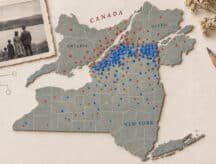
In Clinton County, New York, 6,988 residents told the U.S. Census Bureau they have Canadian or French Canadian ancestry. The county holds 78,493 people, working out to one in every 11.
Franklin County runs close behind at one in 14, and St. Lawrence County sits at one in 17. Clinton, Franklin and St. Lawrence rank first, second and third among all 62 New York counties for Canadian ancestry.
A Canadian law that took effect in December 2025 changed what those numbers mean. Residents who can trace their family line to a Canadian ancestor now hold Canadian citizenship. Their remaining task is documenting it to claim the full rights and benefits of their newfound status.
Get a Free Consultation on Applying for Proof of Canadian Citizenship
Why the ancestry figures are likely an undercount
Ancestry figures come from what people self-disclose on a census form. While these counts are valuable, they are not indicative of how many New Yorkers are Canadians today, since just one Canadian ancestor is enough to pass down citizenship to all their direct descendants.
This is to say nothing of the ancestral information that is lost to time.
Names went first. Leblanc became White. Charpentier became Carpenter. La Rivière became Rivers. Families carrying a dit name, the second surname common in Quebec parish records, often kept one half and dropped the other. Whole branches of a family tree can answer to a name that reveals nothing about where they came from.
Clinton County offers a measure of the gap. Alongside the 6,007 residents claiming French Canadian ancestry, another 11,756 claim French ancestry. Patrick Lacroix, a historian who directs the Acadian Archives at the University of Maine at Fort Kent, found that about 90 percent of Clinton County residents born north of the border in 1860 were French Canadian. The county's French-speaking settlement came from Quebec rather than from France. Some of that larger group describe the same migration with a different word.
Census ancestry records how people describe themselves. Canadian citizenship by descent depends on a documented family line. One Canadian ancestor makes their descendants eligible, including cousins who have never thought of themselves as Canadian. A single name in a parish register can carry thirty living relatives.
Across the ten counties running from the Quebec border to the Capital Region, 34,942 residents report Canadian or French Canadian ancestry. The population there sits just over one million. That's one in 29, give or take a margin of error of about 1,700.
The route south from Quebec
Quebec families followed the water. They came down the Richelieu River into Lake Champlain, through the Champlain Canal, and into the Hudson at Whitehall. The same route carried them to Troy and Cohoes, home to one of the largest textile operations in the country.
They arrived before New England's mill towns filled. Lacroix sampled the 1860 census county by county. More than a quarter of Clinton County's population was Canadian. Plattsburgh and Champlain each held over 2,000 Canadian residents, and in many towns the share approached 30 percent. Malone's figures matched Plattsburgh's. Ogdensburg held about 2,000 Canadians, 41 percent of them with French names.
Those 1860 counts recorded where people were born. The census today records what people call themselves six generations later. Canadian law looks at the first measure.
By 1930, Clinton, Franklin and St. Lawrence each still held more than 5,000 French Canadians. Outside New York City, only Albany County came close.
Get a Free Consultation on Applying for Proof of Canadian Citizenship
Irish and Ontario families qualify too
Ontario families moved into Jefferson and St. Lawrence counties across the same decades. Lacroix's 1860 sample also picked up Canadian-born children of Irish immigrant parents.
That second group matters for anyone in the corridor named Kelly or Donnelly. Quebec City received more Irish arrivals than any other port in British North America. Families who settled in Canada long enough to have a child there, then moved south, left a Canadian-born ancestor in the line.
The standard is strict. Passing through Canada on the way to the United States does not count. The ancestor must have been born in Canada, or have naturalized there. Canadian citizenship did not exist as a legal status until January 1, 1947, so an ancestor who was living in Canada with legal domicile on that date also counts. CIC News has covered which ancestors can anchor a claim.
A law with no generational limit
Bill C-3 came into force on December 15, 2025.
Before that date, Canada cut off citizenship by descent after the first generation born outside the country. A parent born in Canada was enough. A grandparent born in Canada was not.
Parliament removed that limit for anyone born before December 15, 2025, and applied the change backward through the generations. Canadian citizenship can now pass down through an unlimited number of generations, provided documents support the claimed relation to an ancestor.
Americans who suspect a Canadian ancestor in their family line can look for several clues, including surnames, languages spoken at home, and where their family hailed from in the US.
Applicants face no language test, no residency requirement, and no oath. Both countries permit dual citizenship, and claiming Canadian citizenship typically adds no tax obligation.
Proving the line
An application traces the family line one generation at a time. Birth, marriage, baptismal, and death records carry the weight. Marriage certificates matter wherever a surname changed, and in this corridor surnames changed often.
Most family lines in these counties run back to Quebec, where the province splits its records between two offices depending on the age of the document. CanadaVisa maintains multiple guides to requesting documents from different provinces for citizenship by descent claims.
As of September 2026, Immigration, Refugees and Citizenship Canada (IRCC) quotes about 33 months to process a proof of citizenship application, with around 136,000 files waiting. Quebec's archives report requests for vital records are up about 3,000 percent since the law changed.
Residents who want to see where their own family line stands can start with CanadaVisa's citizenship by descent eligibility checker.
Methodology: Ancestry figures come from table B04006 of the U.S. Census Bureau's 2024 American Community Survey five-year estimates. The Bureau tracks "Canadian" and "French Canadian" as separate categories, and both fall under Canada's citizenship by descent provisions, so the figures above combine them. Respondents may report two ancestries, so the combined figure reflects ancestry responses rather than unique residents. Ancestry is self-reported and is not the same as citizenship or a documented chain of descent.
Get a Free Consultation on Applying for Proof of Canadian Citizenship
- Do you need Canadian immigration assistance? Contact the Contact Cohen Immigration Law firm by completing our form
- Send us your feedback or your non-legal assistance questions by emailing us at media@canadavisa.com